Loading the world…

Where people go

What people in shared virtual worlds reveal about places, intentions, and crowds, when nobody tells them where to go.

Scroll

Every evening, people walk in. Nobody gives them a task.

Each point of light is one real person, replayed from telemetry. The building is drawn from its own geometry.

Their paths carve the same corridors.

Scroll to scrub time. Each trail fades, but what it leaves behind accumulates.

Where people stop is a property of the place.

Each column is how often a walk ends on that square metre.

Both halves draw the same map.

0.95rank correlation

Split the crowd in two, with no person in common, and both halves draw the same map.

But where they go next is nearly a guess.

The crowd's own map picks the right spot only 5% of the time.

Until they start to move.

9 → 40%in 8 seconds

Columns show the belief about where this person is heading. Intent, not the map, is the bottleneck.

So we model people as agents with goals.

When to leave. Who or where to go. Then walk. Nothing else is scripted from the recording.

The social structure survives.

Who stands alone and who stands together is reproduced, and it transfers to worlds the model has never seen.
Three places it has never seen.

Predicted zero-shot, trained only on other scenes.

Walk in with them.

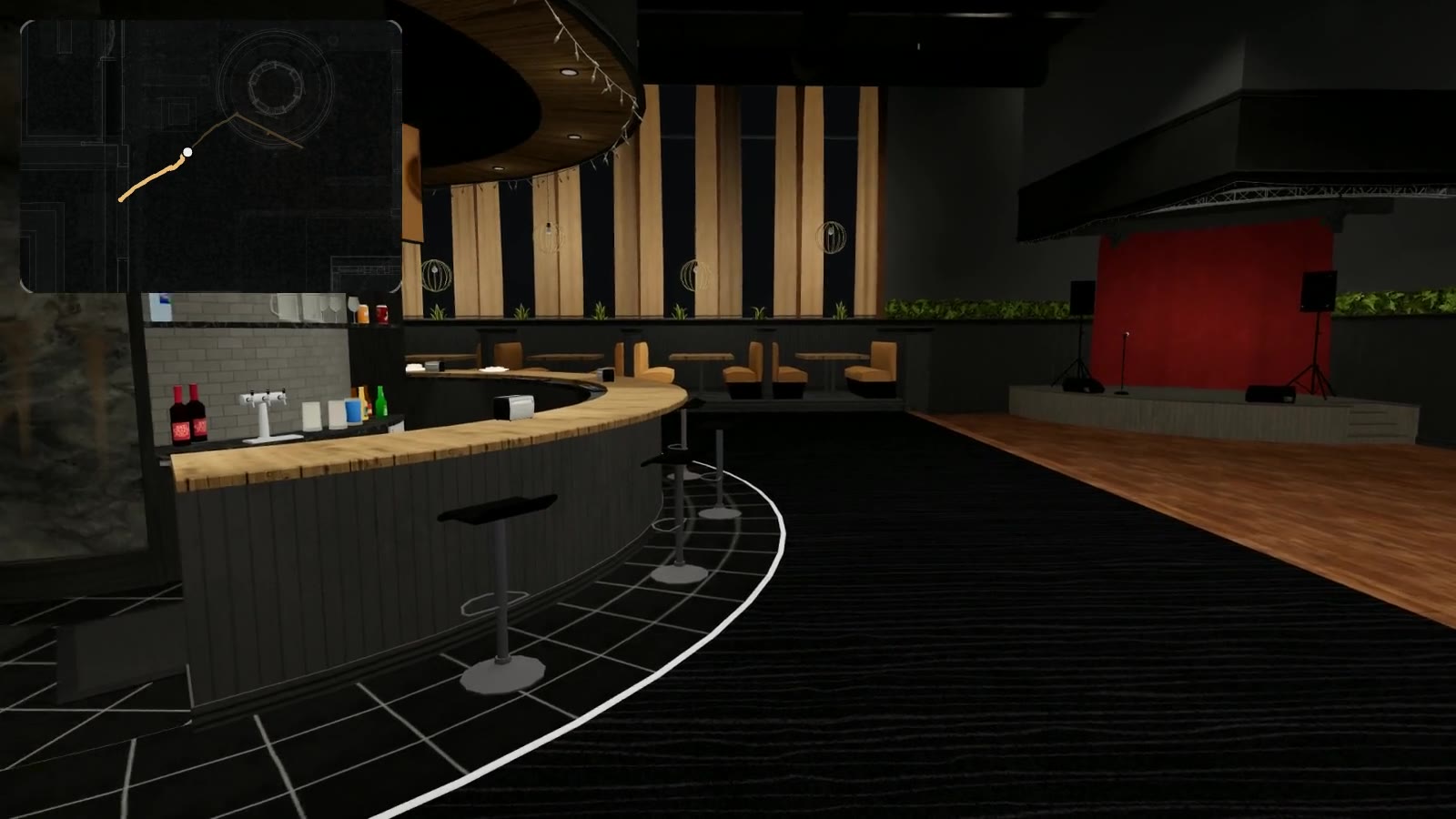
Real arrivals, replayed from measured head position and orientation inside the restored world. Everyone else is animated from the same recording.

The bar counter

27 m in 24 s, straight to the busiest stop in the building.

The back bar

Across the room to the bottles behind the bar.

The neon sign

Through the lounge toward the menu and the open sign.

The bar stools

Around the curve of the bar to an empty seat.

Step inside the recording.

An interactive replay of one walk-in, in the browser. Drag to look around, press play to follow it. About 230 MB.

A world it has never seen.

Fitted only on the bar scene, the simulator runs unchanged in a pub scene it has never seen. Who stands with whom carries over. How restless people are does not.

Twenty minutes of one evening at 40× speed, seen from above. Both views share the same people and the same arrival times.

Four decisions, on repeat.

Every simulated person runs the same loop, once a second. Most of it is learned from the recordings; only who is present is taken from them.

00

Who is here

Arrivals and departures from the room.

01

Stay or go?

A departure hazard for everyone standing still.

02

Who or where?

Head for a person, or for a place.

03

Route

The shortest walkable path there.

04

Walk

Step by step, toward the next waypoint.

Arrive, stand, decide again↺

The numbers, held out.

Person-disjoint splits throughout. Shaded bands are 95% bootstrap intervals over sessions.

0.95agreement between maps drawn by two halves of the crowd
5%of walks called by the map's single best guess
40%top-5 goal hits after eight seconds of motion, up from 9%
0.07error in who stands alone, against 0.62 for a next-step transformer

The individual walk is hard to call at departure

Even with 20 guesses from the crowd's own map, 48% of walks in the bar scene and 68% in the hangout scene are missed.

Nearest popular spotMost popular spotsChance

Social structure survives closed-loop rollout, and transfers

Error in the share of people standing alone. Fitted on the bar scene, applied unchanged to the hangout and pub scenes.

Goal simulatorNo social inputsNext-step transformerNull

Watching the walk reveals the goal

Top-5 goal hits within 3 m, by time since the walk began.

Most of the time, people stay put

Share of windows with under half a metre of movement.

Places are predictable. People are not, until they move.